QR Codes
Brandon Wiley invented an ATM machine this week for complementary currency using QR codes. Writing python code on Google App Engine, he wrote code which can generate a QR code using Google Chart API and an oauth consumer to allow someone to redeem the currency without giving the ATM site the username and password to their account. The transaction was made with the OSCurrency API. Some more API support needs to be done to make the transaction more resistant to counterfeiting, but it already makes a cool demo.
Stupid Currency Tricks with OAuth
We interrupt our regularly scheduled program with a screencast for software developers.
If you are not a software developer, the screencast may not be useful, but it’s good to understand why OAuth is critical to online complementary currency. When you buy something online, you don’t log into your bank’s website to do the transaction. You may click on a PayPal purchase button or some other one-click button. So, a member may not want to log into a community currency website to make a payment to a peer. The community currency website needs to expose an application programming interface to third party applications (like Facebook) to make payments and execute other functions. How is the third party authorized to make a payment on behalf of the member? The OAuth protocol allows a member to seamlessly grant the third party application authorization to perform specific actions on his accounts, for instance. It’s kind of a big deal.
An Improvement to Employee Discounts with Network Effects
At the Next Economy Workshop, Donald Jackson said he was interested in considering currency designs that would support small businesses since they are especially vulnerable during an economic crisis. Yesterday, Donald wrote Alternative Currencies and Independent Business Wages. In Donald’s analysis, a fundamental problem small businesses have is paying competitive wages compared to large corporate firms. The solution:
Let us suppose that on top of existing base pay, local employers added an extra $3-4 dollars worth an hour for their employees. However, instead of being issued in dollars, let us suppose this wage boost is issued in a local currency that is only accepted by those very same firms. All of the local, independent firms in a network issue the wage increase, but those increased wages can only be spent within that local network.
Next Economy Potluck Lunch and Workshop
Next Economy Potluck Lunch and Workshop
Saturday, December 13, 2008 10:30AM - 2:30PM
Ruiz Branch Library, 1600 Grove Blvd, Austin 78741
Register here: http://nexteconomy.eventbrite.com (free)
The resilience needed to absorb hard times can be provided by regional loyalty currencies. Why isn’t anybody doing it, then?
In fact, they are:
- 300 businesses in Berkshire County, Massachusetts accept Berkshares (launched on September 29, 2006).
- 600 businesses in South East Bavaria accept the Chiemgauer (launched in 2003)
- 60,000 businesses in Switzerland accept the Swiss WIR (launched in 1934 by 16 businessmen)
The Swiss WIR was created in response to the scarcity of credit during the depression. The WIR is responsible for the economic resilience of the Swiss economy.
Collective responses for economic relocalization are springing up like mushrooms in Austin. This could have a positive impact on very small businesses, which are particularly vulnerable during economic downturns. Brian Kelsey, economic development coordinator for the Capital Area Council of Governments, is quoted in this week’s Austin Chronicle: “businesses with fewer than 10 employees experienced negative growth in 2001, which implies they may have been disproportionally hurt when the last recession hit.”
This downturn may not be a “normal” recession, but a symptom of the collapse of economic models that no longer work because they’re not sustainable. Our economic assumptions may be transformed over the next months. It’s time to explore alternatives. This is the first in a series of discussions that will consider solutions for the next economy.
Bring a covered dish or drinks, plates, etc. and join fellow weekend economic warriors to talk, learn, and plan.
Onsite childcare available.
OsCurrency Demo Site and Github Repository
At One Web Day Austin on September 22, the idea was offered (see video in previous entry) that it would be relatively straightforward to build a complementary currency system on Insoshi. Shortly after that, Rich and I began a new project in github. The latest code can be found in the edge branch of Oscurrency.
Two weeks ago, the Austin Time Exchange made the switch to running this code. Most of the changes you see in github since then are the result of feedback from the members. This site runs on one 256M slice on slicehost.
One Web Day Austin
[blip.tv http://blip.tv/play/Ac+DBY_Iaw]
We had the opportunity to talk about community currency at One Web Day. There is an archive of talks. It was neat to see Cafe Caffeine’s customers stop in for coffee throughout the evening and stay awhile to listen in on the compelling talks about privacy online and the war for peace. A big thanks to Jon Lebkowsky, Maggie Duval, Paul Walhus and Dusty Reagan for organizing a great event.
Comments
Author: mat
Date: 2008-11-08 15:14:00
Lawrence Lessig at Netroots Nation 2008
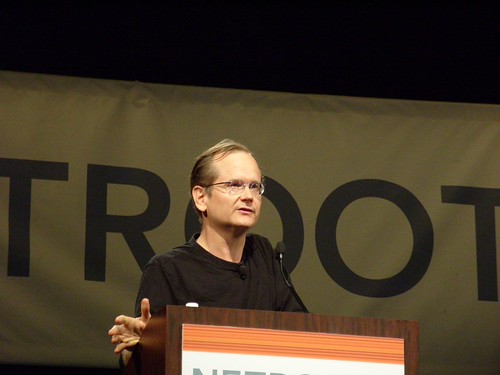
The lunch for Lessig’s keynote at the Austin Convention Center yesterday (NN08) was the standard sandwich box. Each choice had a fancy name. I chose the Wellington. It was pretty good. I’m eating the apple as I blog.
Lessig spent most of the keynote describing the motivation for Change-Congress. On one of his early slides, Lessig noted the problem of socialized risk and privatized profit. In fact, on the day before at the subprime mortgage session, I asked the panel the question I submitted for Nancy Pelosi. Panelist Hale Stewart, who seems like a straight shooter, answered that there’s nothing Congress can do about the conflict of interest of the CEO of JP Morgan Chase making decisions on the Federal Reserve Board to make the public take the risk of the Bear Stearns acquisition.*
unMoney Convergence Day 3 of 3
A list of all the sessions is here. Here’s a brief recollection of the sessions I attended.
A Currency Definition Language by Arthur Brock was the first presentation I attended. Arthur identified the problem (borrowing from John Rogers analogy of taking flight) as our having this dashboard of knobs and dials but we don’t know what they are or there’s no agreement on what to call them. On the previous day, John Rogers noted how the complexity of our financial system corrupts our language. (Language corruption also seems like a consequence of private money creation. Who wants to play a game where someone else gets to change the rules? Truman: “if you can’t beat them, confuse them.”)
unMoney Convergence Day 2 of 3
Brownies for breakfast! Yes!…I walked up Pike Street from the hostel (on 1st) and took note of the Kinkos as I made the right turn on 8th street to the Town Hall on Seneca. Kaliya explained the open space format and we signed up to lead sessions. For the first session, I decided to attend Michael Linton’s presentation “Get the Money Moving.” In the video, Ernie Yacub walks in to assist Michael. I was fortunate to join Ernie and Lori Heath for lunch.
unMoney Convergence Day 1 of 3
[flickr video=2416072066 secret=159e0fd6ed w=400 h=300]
It was a surreal experience today as I’m seeing at least a dozen people for the first time that I’ve only known from the Internets. People came from as far as Germany, England and Australia. Since we didn’t start checking in until 3pm, it was mostly introductions and a dinner that was worth the wait. See you after a little bit of sleep.